


Our story
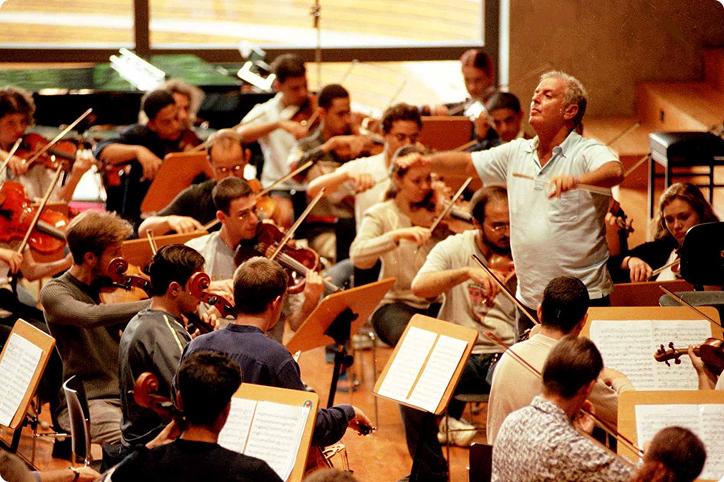
The Foundation has its roots in 1999, when Barenboim and Said promoted in Weimar—European Capital of Culture that year—the creation of the West-Eastern Divan Orchestra, made up of young musicians from Arab countries, Israel, Palestine, and other regions of the world. The orchestra, conceived as a space for meeting and mutual respect amid contexts marked by conflict, was the first tangible step of a radical idea: that music can offer common ground where differences are not eliminated, but rather heard and understood.
The Founders
The impact of this vision was internationally recognized in 2002 with the Prince of Asturias Award for Concord to our founders for their example of intercultural collaboration and their commitment to peace and understanding through music. That same year, the Board of Andalusia proposed that the permanent headquarters of the Orchestra be established in its territory, a region whose history—especially during the Andalusian period—has been a global reference for coexistence among cultures and religions. Inspired by this historical legacy, the Barenboim-Said Foundation was established in 2004 with the mission of promoting musical education, artistic excellence, and the values of dialogue, tolerance, and reconciliation. Since then, the Foundation has developed educational programs, social projects, and cultural collaborations in multiple contexts, carrying forward the spirit of its founders: a spirit that continues to believe that, even in the most difficult moments, music can be a bridge where others see only borders.
DANIEL BARENBOIM
He made his debut as a pianist at the age of ten in Vienna and Rome, and as a conductor in 1967 with the Philharmonia Orchestra in London. Between 1975 and 1989, he was the principal conductor of the Paris Orchestra. From 1991 to 2006, he was the music director of the Chicago Symphony Orchestra and the artistic director of the Teatro alla Scala in Milan from 2011 to 2014. Since 1992, he has been the music director and artistic director of the Staatsoper Berlin.
EDWARD SAID
Graduated from Princeton University and earned a doctorate at Harvard, he taught English and comparative literature at Columbia University from 1963. Author of more than twenty books translated into thirty-five languages, including Orientalism (1978), The Palestinian Question (1979), Covering Islam (1980), The World, the Text, and the Critic (1983), and Parallels and Paradoxes: Reflections on Music and Society (2002, alongside Daniel Barenboim).
The friendship between Daniel Barenboim and Edward Said dates back to a chance meeting in the early nineties in the lobby of a London hotel.
The passion for music and ideas is, without a doubt, the force that unites them.
“I feel at home in the company of a few very close friends. And I must say that Edward has become, for me, that friend with whom I can share so many things, a soulmate. I always feel very much at home whenever I am with him.”
I believe that one of the things Daniel and I have in common is a fixation of the ear rather than the eye.
1999
Weimar 250th anniversary of Goethe’s birth. Creation of the West Eastern Divan Orchestra
2002
Prince of Asturias Award for Concordia
2004
Creation of the foundation
2005
Creation of the foundation
2005
Creation of the foundation 2
2006
Creation of the foundation 3
2007
Creation of the foundation 4